← All Posts

The Name Is a Lie: China OSINT

December 3, 2025 |

You search "Zhang Wei" and get 50 million results. Welcome to Chinese name OSINT.

The techniques that work for investigating John Smith in Ohio don't translate to Chinese names — not because the tools are different, but because the entire naming system operates on different logic. And if you don't understand that logic, you're either drowning in false positives or missing your target entirely.

The pinyin trap

Most Western analysts search Chinese names in pinyin, the romanized spelling. This is the first mistake (though it depends heavily on which platform the target registers on and the characters it allows). Zhang Wei in pinyin could be:

  • 张伟 (Zhāng Wěi)
  • 张威 (Zhāng Wēi)
  • 张维 (Zhāng Wéi)
  • 张卫 (Zhāng Wèi)

Four different people. Four different characters. One pinyin spelling. Now multiply it: Zhang Wei (张伟) is the single most common name in China — estimates put it at over 290,000 people. Searching "Zhang Wei" without the hanzi is like searching "John" and expecting to find your target.

It gets worse. Western databases drop the tone marks.

Even if two names are distinguishable in proper pinyin (Wěi vs Wēi), your database flattens them into the same string. We show a detailed solution for this in the training.

Simplified vs traditional

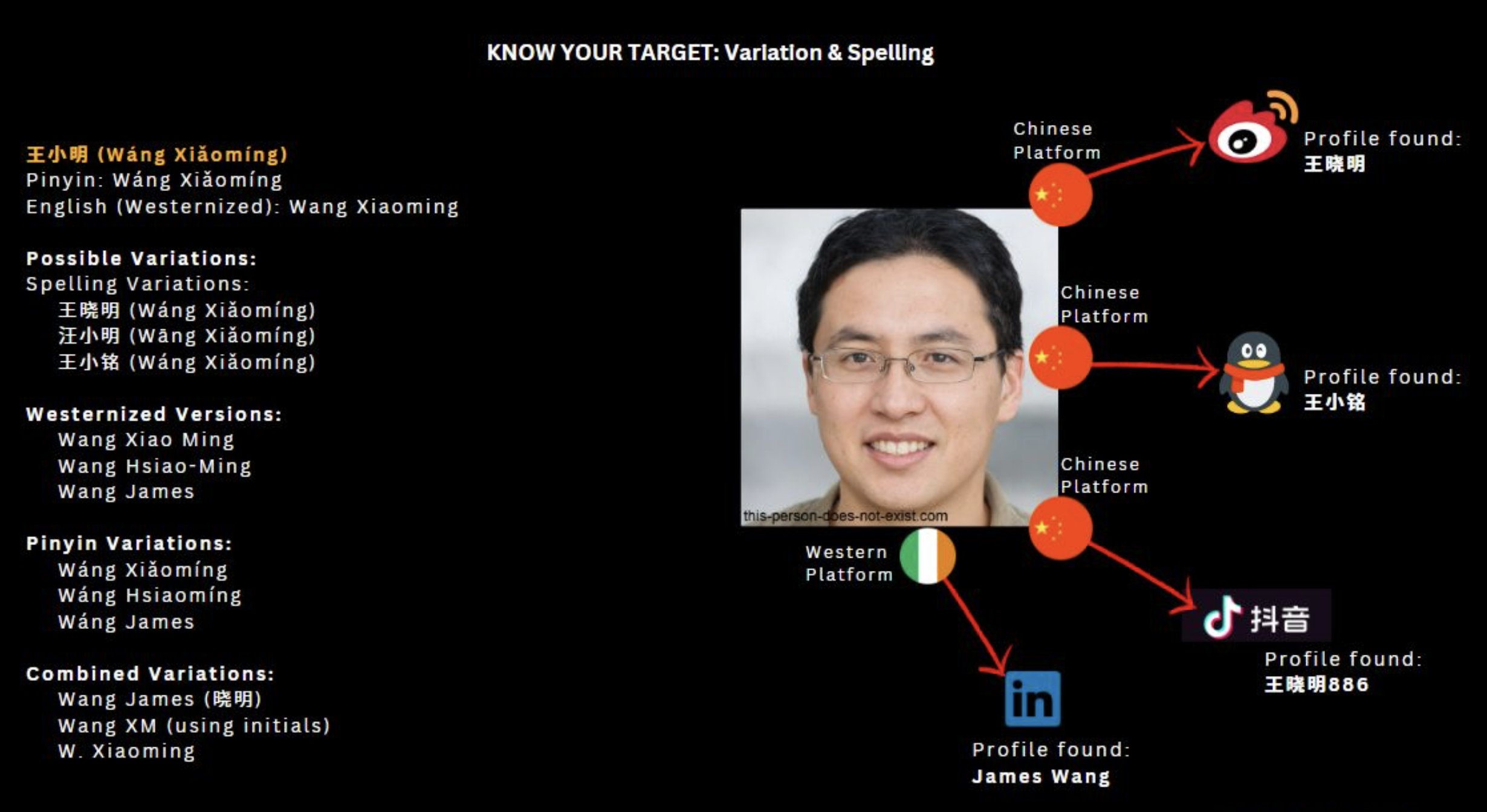
Mainland China uses simplified characters. Taiwan, Hong Kong, and older overseas Chinese communities use traditional. 张伟 (simplified) and 張偉 (traditional) are the same name in different characters. If you're searching Chinese-language databases, you need to know which character set the platform uses and search accordingly — a search in simplified won't return traditional results, and vice versa.

Name-order confusion

Chinese names put the family name first: 习近平 is Xi (family) Jinping (given). But Chinese individuals interacting with Western systems often flip the order, so in a U.S. database you might find "Jinping Xi," "Xi Jinping," and "Xi, Jinping" — the same person, three entries. Now add a Western first name, which many Chinese professionals adopt, and it gets messier. David Wang in San Francisco might be 王大卫 (Wang Dawei) in Chinese records — or his Chinese given name might be completely different. The "David" tells you nothing. It's the same reason a report built on the Western names of your Chinese LinkedIn connections tends to be weak.

When there's no real name at all

Here's the harder problem: your target isn't using their real name anywhere — only nicknames and avatars, which in some Chinese ecosystems is the norm. So how do you identify the digital presence of a target when a Weibo username tells you nothing, a Douyin handle is invented, and the QQ number is just digits?

You stop chasing the name and start chasing the metadata.

  • Avatars get reused. A profile photo on Weibo might appear on Maimai, Zhihu, a gaming forum, or a specialized resource — and one of those platforms has stricter real-name requirements than the others. Reverse-image searching across Chinese platforms surfaces connections that username searches never will.
  • Usernames migrate. Someone using "dragon February 88" on one platform often uses a variation elsewhere — similar structure, same numbers, related references. Pattern recognition across platforms builds a profile even when no single platform gives you the real name.
  • Behavioral fingerprints persist. Posting times, writing style, topic interests, the specific way someone phrases things — these are hard to disguise. A person running multiple accounts leaves consistent traces across all of them.

Platform cross-referencing works because people are lazy — even in sensitive environments, proper OPSEC is hard to maintain. They reuse elements, link accounts for convenience, and post the same content in multiple places. The metadata leaks what the username hides. This is where the real methodology lives: not in searching names, but in correlating identities across fragmented profiles until the real person emerges.

The underlying problem is that Western OSINT methodology treats names as fixed, unique strings. Chinese names are contextual. The same person can appear as five different strings across five databases — and five different people can share one pinyin spelling.

Want to learn how to actually identify individuals across Chinese platforms, even when they're not using real names? China OSINT Essentials covers the full methodology — name-search techniques, platform-specific identity resolution, cross-profile correlation, and the metadata approaches that work when names don't. For the advanced offerings, you can always explore Advanced OSINT on China.

GOT A QUESTION ABOUT OUR TRAININGS?

Not sure which program fits, or whether we cover what you need? Just ask.

We're happy to tell you whether a specific platform, or focus area is included in a given course — and if it's not, whether we can build it in.

Reach out to sales@epcyber.com about:

  • Whether we cover a specific platform (Weibo, Xiaohongshu, Douyin, CSDN, or anything not listed)
  • A particular focus area you need
  • Group rates, team enrollment, and custom corporate bundles
  • Eligibility — if you're unsure whether your organization qualifies
  • Payment options — wire transfer and other methods for organizations
  • Custom or tailored training built around your team's mission
  • Whatever you're trying to accomplish, tell us where you're headed and we'll point you to the right program.
All contact routes

WHY EPCYBER FOR CHINA OSINT?

Read Post