← All Posts

China OSINT: Inside The CCP

December 13, 2025 |

Dandong sits where China meets North Korea. On a clear day you can stand on the Chinese side of the Yalu River and watch North Korean soldiers patrol the opposite bank. It's one of the most strategically sensitive locations in Northeast Asia.

It's also where there was an open door into China's grassroots surveillance apparatus — a Digital Rural Public Service System, one of thousands deployed across rural China. Today we give you a sneak peek into what wasn't meant to be seen by anyone outside the Party structure. This is what CCP control looks like when you're inside the machine.

The system nobody talks about

Western analysts spend a lot of time on China's "big" surveillance — the cameras, facial recognition, the Great Firewall, the social-credit pilots. That stuff makes headlines. It's visible. It's the frontend. The backend is a different picture.

These "Digital Village" systems have been deployed in thousands of townships and counties since the mid-2010s, accelerating after Xi Jinping's push for "Smart Villages" as part of rural modernization. Every province has them. Every county buys one from a regional software vendor. They all work roughly the same way — they turn village administration into population management.

Everyone has a file. Everyone.

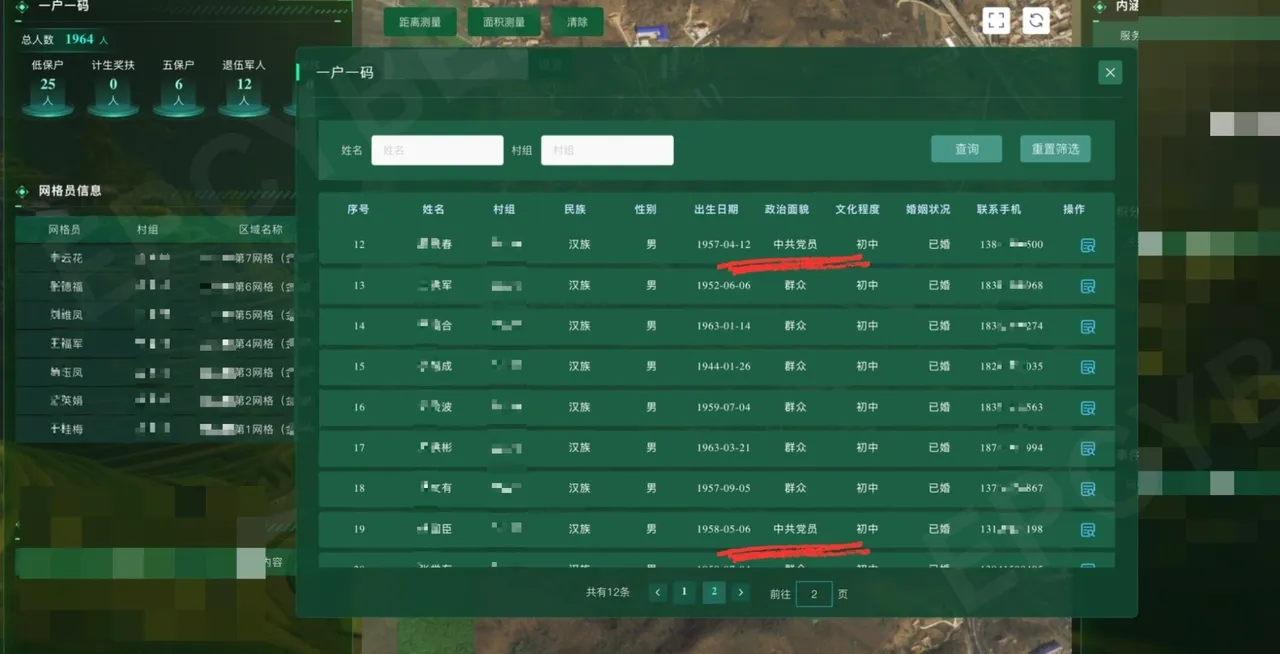
The system tracks every resident in a village of under 2,000 people. This isn't a census. It's an operational database. Party members are flagged in the population registry — the system knows who's in and who isn't. Each resident has a profile with fields that reveal exactly what the Party cares about.

The platform's main dashboard doesn't show population demographics first. It shows problem categories:

  • 低保户 (25) — minimum livelihood guarantee recipients
  • 五保户 (6) — "Five guarantees" households (elderly without children or support)
  • 退伍军人 (12) — military veterans
  • 计生奖扶 — family planning reward recipients (one-child policy compliance)
  • 伤残 — disabled persons

88 Party members. Every meeting logged.

The village has 88 registered Communist Party members out of roughly 2,000 residents — about 4.4%, which tracks with the national average of ~7%. But what's revealing isn't the number. It's what's tracked about each one:

  • 入党时间 — date of Party admission (probationary membership)
  • 转正时间 — date of full membership (after one-year probation)
  • 所在党组织 — assigned Party branch
  • Meeting attendance — which 党员生活会 (Party Life Meetings) they attended
  • Activity participation — events, volunteer work, study sessions
Party member management screen listing admission and full-membership dates
Member management: each Party member's admission date (入党时间), full-membership date (转正时间), branch, and status.

Members are expected to attend regular meetings — typically monthly. They're expected to participate in activities: community service, political study, campaign mobilization. And they're expected to demonstrate "ideological reliability."

A Party organizational-life meeting in session
A 组织生活会 (Party organizational-life meeting), uploaded to the system as attendance documentation.

The grid: seven people watching 2,000

Here's the part most Western analysts miss. The CCP's most effective surveillance system isn't technological at its root. It's a human network.

Grid Management divides every jurisdiction — urban neighborhoods, rural villages, even factory dormitories — into small grids. Each grid gets a manager. The manager's job is simple: know everyone, report everything. The village you see has seven grid managers (网格员), each covering roughly 280 people. The platform shows their names, assignments, coverage areas, and contact and ID data.

One person in every 200–300, watching for the state.

The grid system explains how the CCP can monitor 1.4 billion people without enough police or cameras. They don't need to watch everyone. They just need one person in every neighborhood watching for them.

Party meetings at the militia weapons warehouse

A 党员生活会 (Party Member Life Meeting) was held on August 1, 2024 — China's Army Day — at the 丹东军分区民兵装备仓库: the Dandong Military District Militia Equipment Warehouse. This is a civilian database, recording an activity at a military facility.

Activity detail showing a Party meeting logged at a militia equipment warehouse
Activity detail: a Party Life Meeting logged at the Dandong Military District Militia Equipment Warehouse, starting 2024-08-01.

What this means for China OSINT

If you're doing any kind of research on individuals or organizations in China, here's what this insider look teaches Western analysts:

  • Local files exist on everyone. Not in Beijing — in their local village or neighborhood, updated by someone who knows their face. The concept of "no record" doesn't exist.
  • Political status is the primary filter. 群众 (masses) vs. 中共党员 (Party member) appears in every government database. It determines expectations, obligations, and scrutiny.
  • Welfare categories are watch lists. Veterans, disabled, poor, elderly-without-family — these aren't just benefits categories. They're stability-risk profiles.
  • The grid manager is the first-line sensor. Somewhere in China there's a person assigned to know your target's schedule, visitors, and habits. That person files reports.
  • Party membership is tracked like a job. Attendance logged, participation scored, reliability assessed. A member is inside a monitoring system.
  • Military and civilian systems overlap. Especially in border regions. Village databases may reference military facilities, militia units, and garrison activities.

This is what China OSINT looks like at ground level — not policy papers and think-tank reports, but the actual systems running the country. Our Advanced OSINT on China course teaches you how to navigate these structures, interpret Chinese data sources, and understand what you're actually looking at when you find something like this.

GOT A QUESTION ABOUT OUR TRAININGS?

Not sure which program fits, or whether we cover what you need? Just ask.

We're happy to tell you whether a specific platform, or focus area is included in a given course — and if it's not, whether we can build it in.

Reach out to sales@epcyber.com about:

  • Whether we cover a specific platform (Weibo, Xiaohongshu, Douyin, CSDN, or anything not listed)
  • A particular focus area you need
  • Group rates, team enrollment, and custom corporate bundles
  • Eligibility — if you're unsure whether your organization qualifies
  • Payment options — wire transfer and other methods for organizations
  • Custom or tailored training built around your team's mission
  • Whatever you're trying to accomplish, tell us where you're headed and we'll point you to the right program.
All contact routes

WHY EPCYBER FOR CHINA OSINT?

Read Post